
The Reality of Legacy System Complexity
Most legacy systems were not built in a single project. They evolved over decades through enhancements, regulatory changes, and expanding business requirements.
Understanding this accumulated complexity is the first step toward successful modernization.
PATTERN
DAO Layer
PURPOSE
Data Abstraction
BENEFIT
Maintainability
OUTCOME
Scalable Architecture
Why Modernization Without Discovery Is Risky
Legacy system complexity develops over decades as applications evolve through business growth, regulatory changes, and continuous enhancement.
Over time, the architecture often becomes difficult to fully understand.
Even organizations that have maintained these systems for years often do not have a complete map of how everything fits together.
Understanding Legacy System Complexity at Scale
Thousands
of Programs
One Million
Lines of Code
Hundreds
of Database Tables
Dozens
of Batch Streams
Multiple
External Integrations
Embedded
Legacy applications rarely consist of a single program or database. Over years of continuous enhancement, organizations accumulate thousands of programs, hundreds of database tables, batch processing jobs, reporting engines, and integrations with external systems. Each addition increases system complexity, making modernization significantly more difficult without comprehensive discovery for enterprise architecture.
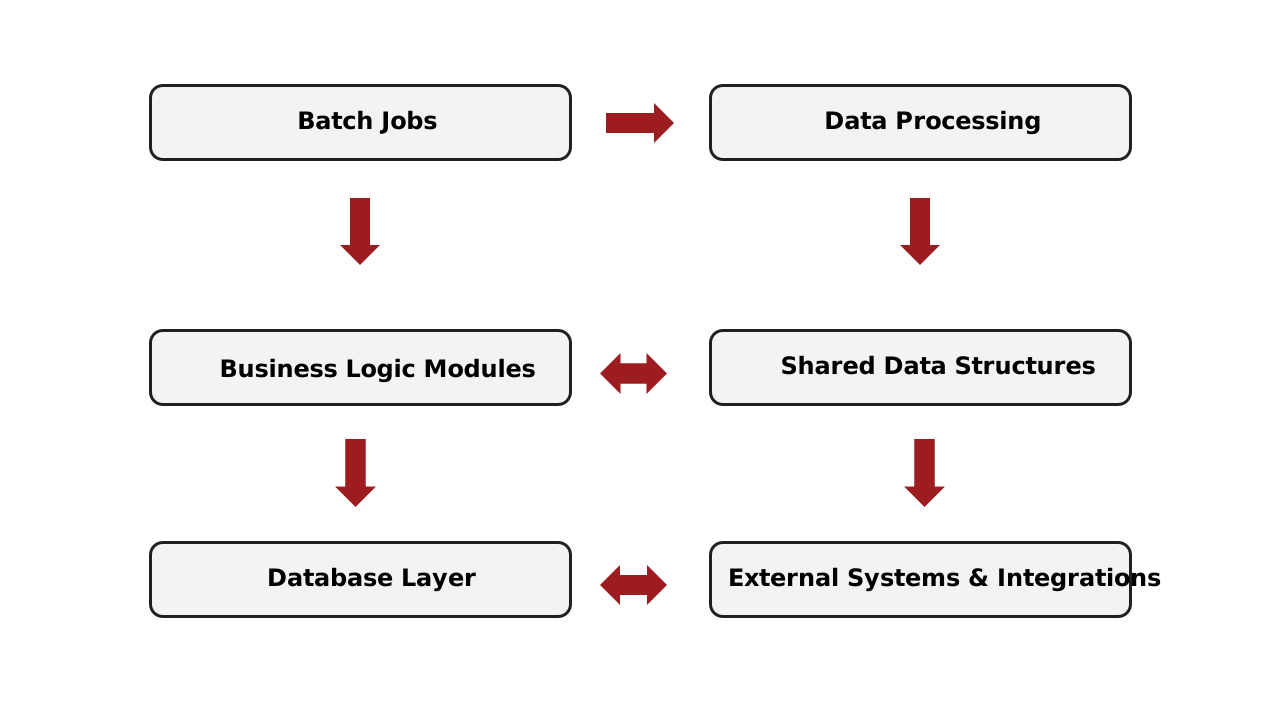
How Legacy System Complexity Develops Internally
Over decades of development, relationships between system components become deeply interconnected.
Batch processing, data structures, application logic, and integrations with external systems form a complex network of dependencies.
Changes made in one part of the system can affect multiple other components in ways that are not immediately visible.
Although individual components may appear independent, they frequently share business rules, common data structures, and hidden dependencies that have evolved over many years. A seemingly simple modification in one area can unexpectedly affect reports, interfaces, or downstream business processes, making complete system visibility essential before engineering work begins.
This legacy system complexity often remains hidden until modernization efforts begin, making early discovery essential.
Why Modernization Without Discovery Is Risky
Organizations sometimes begin modernization initiatives based only on high-level understanding of their systems.
Without structured discovery, projects often encounter unexpected challenges such as:
Undocumented Dependencies
Programs and modules may depend on each other in ways that are not clearly documented.
Hidden Business Rules
Business logic may be embedded across many programs and scripts.
Complex Processing Logic
Batch processes and data flows often contain critical logic that can be missed during analysis.
Embedded Data Structures
Critical data structures may be embedded directly inside application code rather than isolated in database schemas.
Inter-Module Relationships
Programs and components often depend on each other through complex relationships that are difficult to identify without detailed analysis.
These surprises typically appear late in the project, when engineering work is already underway.
From Unknown Complexity To A Clear Blueprint
Producing a Complete Modernization Blueprint
After the AI-guided assessment is completed, the legacy application becomes a fully mapped system architecture, providing:
Complete Program Inventory
Dependency Maps
Business Rule Identification
Data Flow Analysis
Modernization Complexity Scoring
The blueprint transforms legacy system complexity into a structured architectural model for the CORE Migration Method, ensuring that modernization proceeds with full system knowledge rather than assumptions.
Once the discovery process is complete, organizations gain a comprehensive architectural model that serves as the foundation for modernization planning. Engineers can identify technical risks, estimate migration effort, validate dependencies, and prioritize modernization activities based on factual system knowledge instead of assumptions. This significantly reduces uncertainty and improves project predictability throughout implementation.
Software engineering guidance from NIST also highlights the importance of understanding system architecture before modernization projects begin.
Why Discovery Comes First
Successful modernization begins with understanding rather than coding. Before organizations migrate to Java, .NET, cloud platforms, or modern databases, they must first understand how existing applications operate. AI-assisted discovery reveals hidden dependencies, embedded business rules, data relationships, and integration points that would otherwise remain invisible. By identifying these elements before engineering begins, modernization projects become more predictable, more accurate, and significantly less risky. Successfully reducing legacy system complexity begins with understanding the application before engineering starts. AI-guided discovery provides the visibility needed to modernize legacy systems with less risk and greater confidence.
Start With System Discovery
Understanding the architecture of your legacy systems is the first step toward successful modernization.