
Legacy application modernization for COBOL, IBM i and PowerHouse systems
Extend your team. Or let CORE lead the project.
If your business depends on COBOL, IBM i (AS/400), PowerHouse or another legacy language, you know that modernizing it takes more than rewriting code. You need to understand how it works today, preserve the business rules people rely on, and plan a safe path forward.
CORE Migration combines experienced specialists with AI-assisted tools to do exactly that, from design recovery and business rules extraction through engineering, testing and go-live. We can join your team, share the work with your staff, or lead the entire project.
COBOL · IBM i / AS/400 · PowerHouse · Java · .NET
- 1. Plan Release
- 2. Design Recovery
- 3. Forward Engineering
- 4. Test Release
- 5. Deploy Release
Modernization expertise that fits your project
Bring CORE into the work where you need us most. We agree the scope, responsibilities and deliverables with your team before delivery begins.
Extend your project team
Bring in CORE’s legacy and modern application specialists for the work your team needs help with, whether that’s understanding an older application, extracting business rules, converting data or testing the new system. We work within your project structure, on the tasks you assign.
Deliver together
Your people know the business. We know legacy modernization. We work side by side, share responsibility for delivery, and bring CORE’s tools and methods to discovery, engineering and validation, keeping your team involved at every step.
Let CORE lead delivery
When you need one team to take responsibility for a defined modernization project, CORE leads the work from design recovery and business rules extraction through engineering, testing and go-live readiness. Your team stays involved in business decisions, requirements validation and acceptance.
Legacy application modernization services, from discovery to go-live readiness
Start with a focused engagement or bring the stages together in one modernization project.
Assessment and design recovery
Understand the system before you change it. CORE examines how your current application really works, including its code, data structures, integrations, business rules and dependencies. You get a clear modernization scope, an honest view of the risks, and a practical delivery plan before major changes begin.
Business rules extraction
Important calculations, validations and decisions are often buried in legacy code, and sometimes nobody still on staff knows they exist. We find and document those rules, then review them with your business and technical staff so they can be trusted as requirements for the new system.
Application and data modernization
Once the current system is understood, we move your application and data to the platform you choose, such as Java or .NET. CORE handles the engineering, data conversion and integrations together, so the new system does what the old one did and is easier to maintain and extend.
Testing and go-live readiness
A new application has to do the right things, not just compile and run. CORE tests the new system against the old one: we compare behaviour, reconcile converted data and track down every difference. We support system testing, user acceptance testing and release preparation, all measured against the acceptance criteria you set.
COBOL, IBM i (AS/400) and PowerHouse modernization
These systems often run work the business can’t afford to get wrong, and each has its own language, data structures and history. Modernizing them takes more than a generic rewrite plan. CORE brings people who know these platforms from the inside, together with the modern engineering skills needed to move them to Java, .NET and current databases. CORE has been modernizing these platforms for 25 years
COBOL modernization
COBOL applications often hold decades of business logic spread across programs, copybooks, JCL and batch jobs. CORE recovers that logic, then moves the application and its data, including VSAM, DB2 and flat files, to Java, .NET or the platform you choose. We handle the analysis, engineering, data conversion and testing, so nothing the business relies on gets lost along the way.
IBM i (AS/400) modernization
IBM i applications often combine RPG and CL programs, DDS-defined files, DB2 for i data and green-screen interfaces built up over many years. CORE recovers the business rules in that code and helps you decide on the right path, whether that’s moving to Java, .NET or a new database, or modernizing parts of the system in stages. We then handle the engineering, data migration, integration and testing to get you there.
PowerHouse migration
PowerHouse 4GL applications built with QUICK, QUIZ, QTP and QDESIGN often run on OpenVMS, HP 3000 or Unix, with data in RMS, Image or relational files defined in the PowerHouse dictionary. CORE has deep, hands-on experience with all of it. We recover the application logic and move it to Java ot NET, with the data converted to SQL Server or Oracle, then test the result against the original system.
Experience with complex legacy applications
CORE has moved PowerHouse, COBOL and HP-UX applications to Java, .NET and SQL Server, including desktop systems rebuilt as .NET/WPF applications. Each project started with understanding how the existing system really worked, and each ended with a new system the business could rely on. Here are some examples.
Federal Judicial Affairs
PowerHouse and HP-UX applications modernized to Microsoft .NET and SQL Server.
Freightways
Modernization involving PowerHouse, COBOL and an HP e3000 environment.
Ontario healthcare billing
PowerHouse and COBOL modernization to a .NET/WPF application backed by SQL Server.
A structured path from legacy code to go-live readiness
Every application is different, but most modernization projects need to answer the same five questions. CORE combines design recovery, repository-driven engineering and structured testing to answer them, with agreed outputs and review points at each stage, so decisions don’t get left until the end.
Assess and plan
What do we have? Understand the application, data, dependencies and priorities, then agree on the scope and delivery approach.
Recover the design
How does it really work? Document the business rules, application structure and data relationships.
Engineer the target solution
What needs to change? Build the agreed application, database and integration changes on the target platform.
Test and validate
Does it behave correctly? Compare behaviour with the original system, reconcile the data and resolve every difference against your acceptance criteria.
Prepare for go-live
Are we ready to release? Complete release planning, handover and readiness activities with your team.
Experienced people, supported by CORE OneTool.
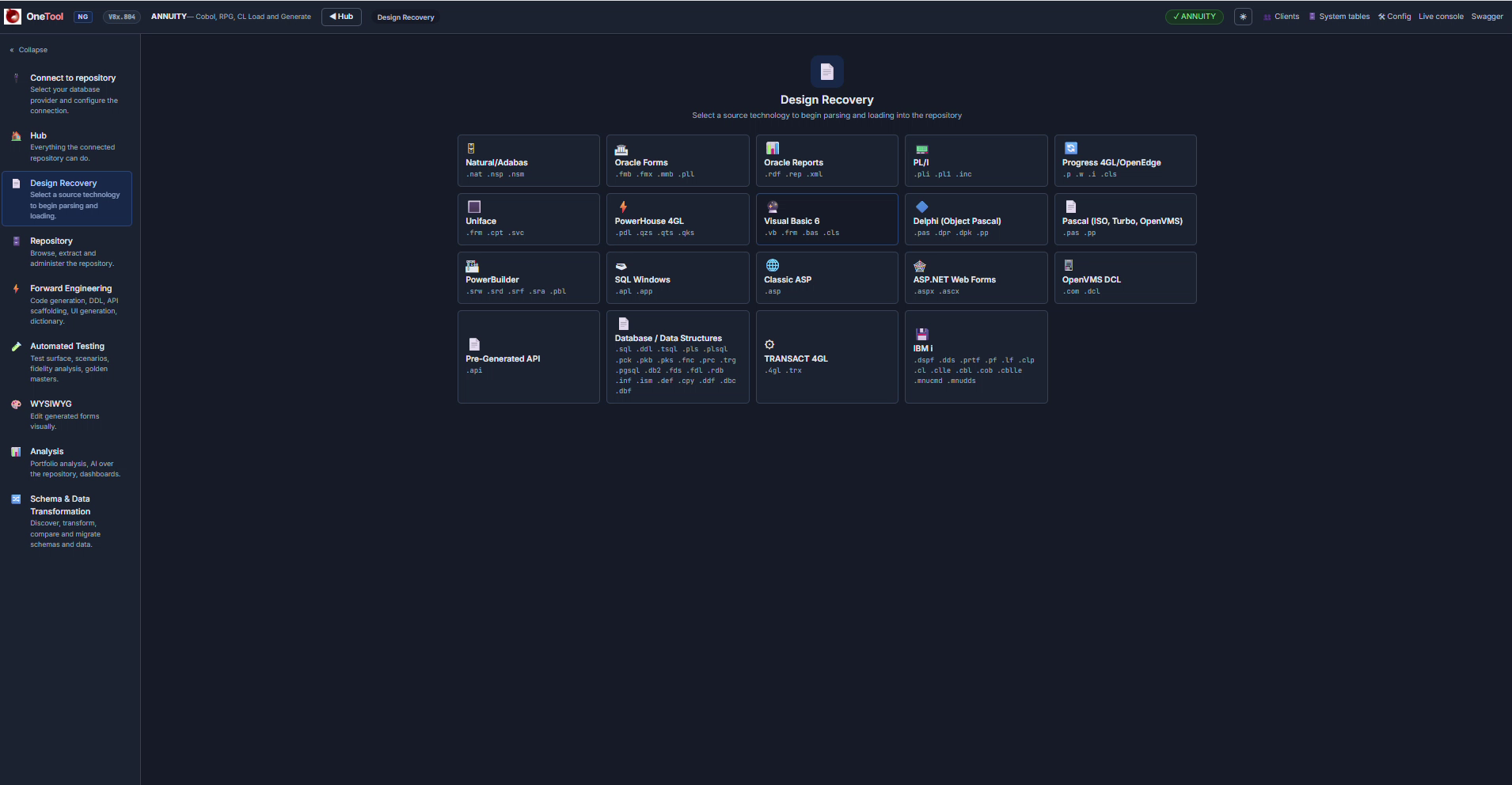
CORE OneTool is modernization software built by the team behind CORE Migration. Our specialists use its design recovery, repository and forward engineering capabilities, along with AI-assisted analysis, to work faster and more consistently. Every result is reviewed by people who know the platform, so the tools speed up the work without taking judgment out of it.
If you need a modernization team, talk to CORE Migration. If you’re looking for software to support your own team, explore CORE OneTool.
Questions about working with CORE Migration
Can CORE work alongside our existing team?
Yes. We can add specialists to your project team or share the delivery work with your staff. Before work begins, we agree on responsibilities, deliverables and how progress will be reviewed.
Can CORE lead the whole modernization project?
Yes. We can lead a defined project from assessment and design recovery through business rules extraction, application engineering, data conversion, testing and go-live readiness. Your team stays involved in business decisions and acceptance.
How do you use AI in legacy modernization?
We use AI-assisted tools, together with source code analysis and repository-driven engineering, to analyze legacy applications faster. Specialists review every result, and recovered rules and new application behaviour are checked with your team and confirmed through testing.
Can we start with business rules extraction?
Yes. Many clients start with a focused design recovery and business rules extraction engagement. It documents what the existing system really does and gives you a solid basis for deciding what comes next.
What is the difference between CORE Migration and CORE OneTool?
CORE Migration provides modernization specialists and project delivery. CORE OneTool is the modernization software built by the CORE team, which our specialists use and which is also available to organizations running their own projects.
Tell us what you're working with
What platform does your application run on, what do you want to change, and where could your team use support? Tell us a little about the project, and we’ll talk through a practical next step, whether that’s business rules extraction, a modernization plan, extra specialists or a CORE-led project.