
The Legacy Modernization Risk Curve
Why traditional rewrite projects increase risk, and how the CORE Migration Method reduces it.
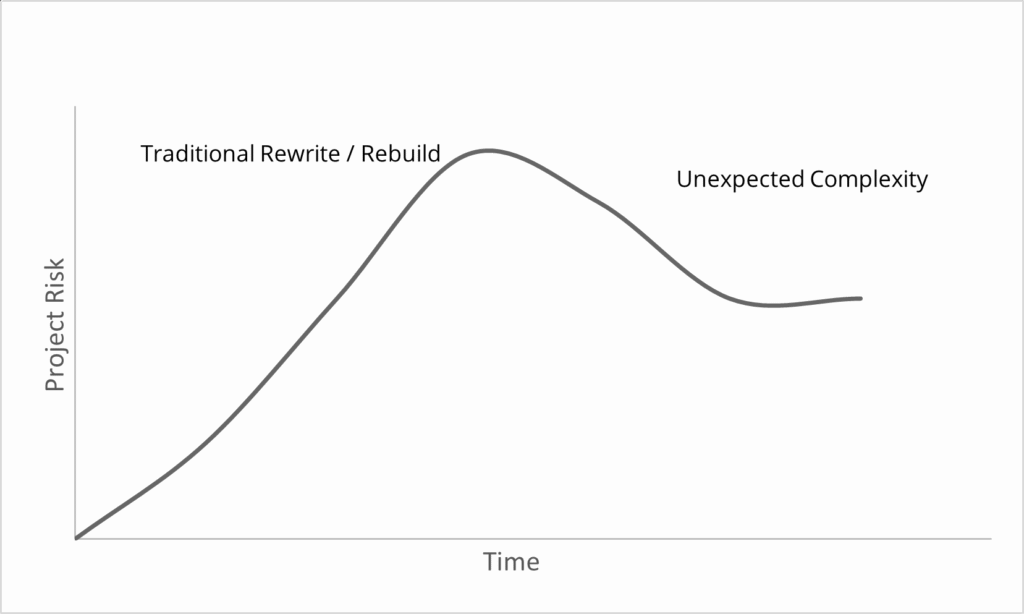
The Legacy Modernization Risk Curve illustrates why many traditional software modernization projects become riskier as development progresses.
Legacy modernization projects often fail not because of technology limitations, but because hidden system complexity emerges late in the project lifecycle.
Traditional rewrite or rebuild approaches frequently begin engineering before the full structure of the system is understood. As development progresses, unexpected dependencies, undocumented business rules, and hidden integrations begin to surface.
As these discoveries accumulate, project risk increases dramatically.
Traditional Risk Curve VS CORE'S Risk Curve
The Legacy Modernization Risk Curve demonstrates why identifying hidden complexity early leads to more predictable modernization outcomes.
Traditional modernization projects often begin with incomplete knowledge of the existing application. Hidden integrations, undocumented business rules, custom reporting logic, and data dependencies may not be discovered until development is well underway. Each new discovery increases project scope, introduces additional testing requirements, and can delay delivery schedules. Understanding these risks early is essential for a successful modernization initiative.
Industry guidance from the NIST Secure Software Development Framework (SSDF) also emphasizes understanding system architecture and reducing implementation risk before development begins.
How the Legacy Modernization Risk Curve Is Reduced
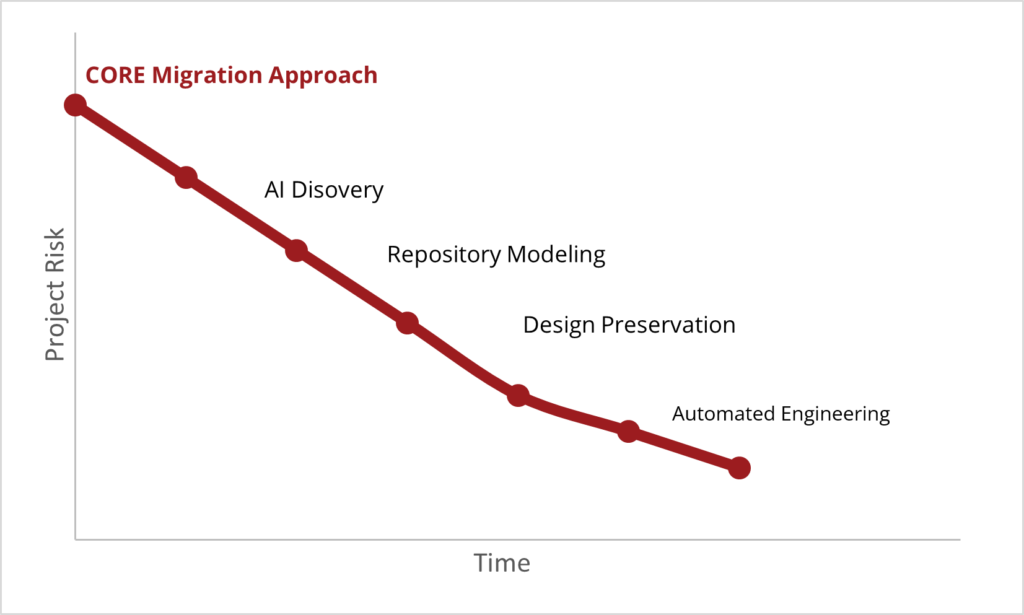
CORE takes a different approach. The modernization process begins with AI-guided discovery and system modeling before engineering begins. By analyzing the system first and constructing a repository-based blueprint, the major uncertainties are identified early.
Once the system structure is understood, modernization proceeds through a controlled engineering process that preserves the system’s design and logic.
This causes project risk to decrease over time rather than increase.
Rather than beginning development immediately, CORE first builds a complete understanding of the application through AI-guided discovery and repository analysis. Business rules, data structures, user interfaces, reports, batch processes, and system integrations are documented before engineering work begins. This creates a shared understanding of the system for both technical teams and business stakeholders, reducing uncertainty throughout the modernization project.
Because the system is fully understood before implementation, engineering teams can estimate timelines more accurately, identify potential challenges earlier, and preserve critical business functionality during migration. Following CORE’s Legacy Modernization Risk Curve allows organizations to reduce uncertainty before engineering begins.
The Result: Predictable Modernization
- early discovery of system complexity
- controlled engineering timelines
- preservation of business logic
- fewer surprises during implementation
Instead of discovering problems late in the project, CORE identifies them before engineering begins, allowing modernization to proceed with confidence.
Traditional rewrite projects often increase risk as hidden complexity emerges. The CORE Migration Method reduces risk early through AI discovery and repository-driven system modeling.
By following the Legacy Modernization Risk Curve, organizations can significantly reduce project risk and improve delivery confidence. Predictable modernization enables organizations to make informed business decisions throughout the project lifecycle. Instead of reacting to unexpected technical discoveries, project teams can focus on delivering planned functionality according to an established roadmap. This improves stakeholder confidence, reduces costly rework, and increases the likelihood of delivering the modernization project on schedule and within budget.
Why Early Discovery Matters
Every legacy application contains years or decades of accumulated business knowledge. Much of this knowledge exists only within source code, configuration files, databases, or undocumented operational processes. Without first discovering this information, modernization teams are forced to make assumptions that often prove incorrect later in the project.
Early discovery reduces technical uncertainty by identifying hidden dependencies before engineering begins. It also allows organizations to prioritize modernization work based on actual system complexity rather than estimates, improving planning, budgeting, and project governance.
Frequently Asked Questions
Why do modernization projects become riskier over time?
Projects become riskier when hidden dependencies, undocumented business logic, or unexpected integrations are discovered after development has already started.
How does CORE reduce modernization risk?
CORE performs AI-guided discovery, repository analysis, and design preservation before implementation begins, allowing engineering teams to work from a complete understanding of the application.
Can this approach reduce project delays?
Yes. Early discovery reduces unexpected work during implementation, helping organizations maintain predictable schedules and budgets.
Start a Discovery Conversation
Learn how the CORE Migration Method reduces modernization risk and delivers predictable results.