
Repository-Driven Modernization
The Foundation of the CORE Migration Method
Explore Related Items
Find out more related insights to help you understand your project better.
The CORE Migration Method
Find out more about the CORE Migration Method and why it fits your needs.
Transforming Systems Through Architecture Modeling
Most modernization projects attempt to translate legacy code directly from one language to another. This approach often produces systems that are difficult to maintain and still tightly coupled to the structure of the original application.
CORE uses a different approach.
At the heart of the CORE Migration Method is a repository-driven modernization platform that models the legacy system in a language-neutral architecture before any code is generated.
Repository-driven modernization begins by creating a structured representation of the existing application before any engineering changes are made. Rather than relying solely on source code or documentation, the repository captures relationships between programs, databases, interfaces, reports, business rules, and external systems. This model becomes a single source of truth for the modernization project, allowing architects and developers to understand the complete application landscape before implementation begins.
Why Repository-Driven Modernization Matters
Legacy applications contain complex relationships between programs, data structures, and business logic.
When these relationships are analyzed and captured in a repository, the system becomes easier to understand and modernize.
A well-constructed repository eliminates much of the uncertainty that traditionally exists in legacy modernization projects. Instead of searching through thousands of source files or relying on institutional knowledge, project teams can quickly locate dependencies, trace business logic, and identify integration points. This reduces analysis time while improving the quality and consistency of engineering decisions throughout the modernization effort.
The CORE repository captures:
Programs
Database tables
Business rules
Dependencies
Data access patterns
Batch workflows
Language-Neutral System Modeling
One of the key advantages of the repository model is that it separates the logical structure of the application from its original programming language.
Because the repository captures application structure independently of the implementation language, organizations can analyze systems developed in COBOL, PowerBuilder, RPG, Natural, PowerHouse, Java, .NET, and many other technologies using the same modeling approach. This allows modernization teams to compare systems consistently while preserving the original business logic regardless of the underlying platform.
Legacy systems may be written in technologies such as:
COBOL
PowerBuilder
Visual Basic
PL/SQL
C/C++
Shell Scripts
Repository-Driven Modernization Blueprint
Once the application has been loaded into the repository, CORE engineers gain a complete view of the system.
This enables:
Accurate Planning
Dependency identification
Business rule analysis
Unused component detection
Data flow analysis
The repository serves as a planning framework for the entire modernization lifecycle. Architects can identify areas of technical complexity, estimate migration effort, define implementation phases, and validate dependencies before engineering work begins. This planning process reduces rework, improves project estimates, and provides stakeholders with greater confidence throughout the modernization initiative.
Supporting AI Analysis
Because the system is modeled in a structured repository, it can be analyzed at scale using AI-assisted techniques. Artificial intelligence produces more reliable recommendations when it operates on structured system knowledge rather than isolated source code. The repository provides AI with relationships between programs, databases, user interfaces, reports, batch processes, and business rules, allowing analysis to consider the application as a complete system. This improves dependency discovery, identifies hidden implementation patterns, and helps engineering teams preserve existing functionality during modernization.
AI tools can examine relationships across thousands of programs, revealing:
Hidden Dependencies
Repeated Rules
Complexity patterns
Data lineage
Modern software engineering guidance published by the National Institute of Standards and Technology (NIST) emphasizes understanding software architecture and system relationships before making significant engineering changes.
The Role of the Repository in the CORE Migration Method
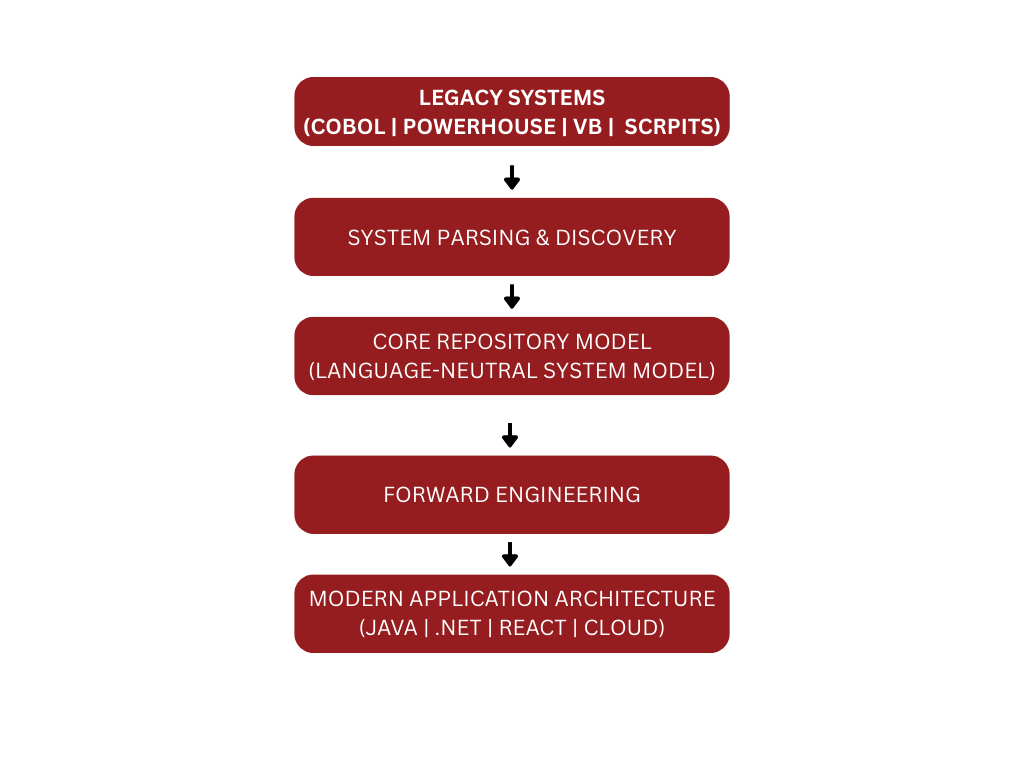
The repository sits at the center of the CORE modernization pipeline. Throughout the modernization process, the repository continuously supports engineering activities by validating design decisions, tracking system relationships, and providing a consistent reference for developers, architects, testers, and project stakeholders. Rather than becoming obsolete after analysis, the repository remains a valuable engineering asset throughout implementation and future maintenance.
Design Preservation Engineering
One of the greatest risks in legacy modernization is losing critical business logic during transformation.
Many legacy applications contain decades of accumulated business knowledge embedded in their processing logic. Rewriting these systems from scratch often results in subtle behavioral differences that can affect operations.
Instead of redesigning the system from the ground up, CORE preserves the functional behavior and logic of the existing application while reconstructing it using modern technologies.
Financial Calculations
Regulatory logic
Operational Rules
Business workflows
Design preservation allows organizations to modernize technology while maintaining the business behaviour users depend upon. By preserving application workflows, business rules, and operational processes, organizations reduce user retraining, minimize operational disruption, and simplify system validation during deployment.
Software modernization best practices promoted by the IEEE Computer Society also emphasize preserving application behaviour while evolving the underlying technology.
Forward Engineering Automation
Once a legacy application has been analyzed and modeled in the CORE repository, the next step is reconstruction into a modern technology stack.
CORE performs this transformation using Forward Engineering Automation.
Forward engineering reconstructs the application from the repository model into modern programming languages and architectures.
This approach ensures that modernization is systematic, repeatable, and scalable.
Data Access Layer
Business Logic Layer
Presentation Layer
Once repository analysis is complete, engineering automation can generate portions of the new application architecture using standardized development patterns. This accelerates implementation while maintaining consistency across the modernized system. Developers spend less time recreating repetitive structures and more time focusing on business-specific functionality.
Benefits of Repository-Driven Modernization
Organizations adopting a repository-driven modernization strategy benefit from improved planning, greater engineering consistency, and reduced project uncertainty. Because the system is fully analyzed before implementation begins, modernization projects experience fewer unexpected discoveries, more accurate delivery estimates, and better preservation of critical business functionality.
Repository-driven modernization also creates long-term value beyond the migration itself. The resulting system documentation provides future development teams with a comprehensive understanding of the application’s architecture, making ongoing maintenance, enhancements, and future technology upgrades significantly easier.
Modernize Legacy Systems with Confidence
CORE’s repository-driven modernization platform enables organizations to transform complex legacy systems with far greater confidence than traditional rewrite projects.