
Case Studies
ESDC Technical Modernization Assessment
ESDC Technical Modernization Assessment Overview
The ESDC Technical Modernization Assessment examined five legacy business applications relied upon by Employment and Social Development Canada (ESDC) built on PowerBuilder 12.5 / Sybase and Oracle technologies. These systems supported critical functions such as labor relations, injury compensation, dispute resolution, and regulatory compliance. However, the aging platforms posed risks, lacked integration with modern enterprise systems, and were increasingly costly to support.
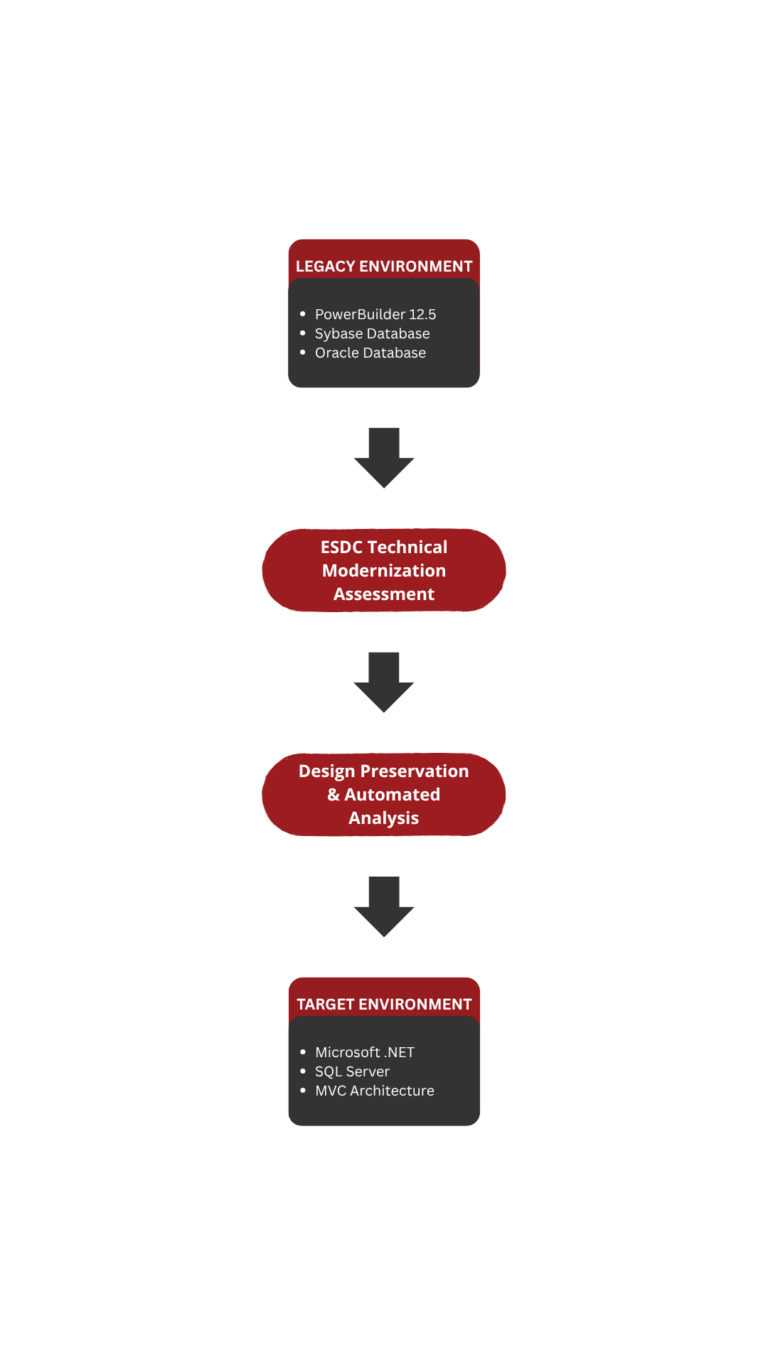
To address this, ESDC engaged Core Software to assess and modernize the applications using automated design-preservation and code-transformation techniques, migrating them to a Microsoft .NET and SQL Server–based architecture (with Oracle retained for specific applications).
Challenges Identified During the ESDC Technical Modernization Assessment
The ESDC Technical Modernization Assessment identified several critical issues affecting the legacy application environment:
The legacy applications created several issues for ESDC:
– Obsolete technology: PowerBuilder/Sybase were no longer strategic standards and nearing end of vendor support.
– Resource scarcity: Skilled PowerBuilder developers were becoming difficult and costly to retain.
– Integration limitations: The systems could not easily integrate with Microsoft .NET, SQL Server, or other enterprise tools.
– Operational risks: High maintenance costs, risk of code duplication, and outdated bilingual design patterns.
– Growth constraints: Legacy platforms limited scalability, modernization of workflows, and improved reporting.
These factors made continued reliance on the systems unsustainable and placed critical business processes at risk.
Modernization Approach
Core Software executed a comprehensive technical modernization assessment and designed a structured roadmap. Microsoft’s modernization guidance for enterprise applications recommends phased modernization strategies that reduce risk and improve long-term maintainability.
Key steps included:
– Design Recovery & Reverse Engineering: Captured business rules, architecture, and logic from legacy systems.
– Code Analysis & Reduction: Identified unused objects and duplicated code (notably bilingual redundancies), lowering modernization scope.
– Database Modernization: Migrated Sybase-based applications (NICS, iNICS, WICS) to SQL Server; retained Oracle for FMCSIS and LA2000.
– Forward Engineering: Applied automated parsing and transformation to generate .NET objects from PowerBuilder equivalents.
– Proof of Concept: Delivered a modernized prototype of NICS Claims Processing with updated UI (WET 4.0 compliance).
– Project Phasing: Developed incremental “Code Drops” with defined timelines per application.
The ESDC Technical Modernization Assessment ensured accurate code preservation, minimized migration risk, and aligned future modernization efforts with enterprise standards. The modernization strategy ensured accurate code preservation, minimized risk, and aligned all applications with ESDC’s enterprise standards.
ESDC Technical Modernization Assessment Results
The ESDC Technical Modernization Assessment prepared ESDC for the full migration of its mission-critical applications. Expected outcomes included:
– Improved maintainability through consolidation of duplicated code and elimination of unreferenced objects.
– Modern, scalable architecture leveraging Microsoft .NET, SQL Server, and Oracle where appropriate.
– Reduced operational costs by moving away from scarce PowerBuilder resources to readily available .NET developers.
– Future-ready applications with web-based access, WET 4.0 compliance, and improved integration with enterprise IT systems.
– Optimized project delivery with defined work schedules (6–13 months per system) and reduced migration scope.
Government digital modernization initiatives frequently emphasize incremental modernization rather than large-scale replacement projects.
The ESDC Technical Modernization Assessment provided the foundation for a structured modernization roadmap that reduced risk and improved long-term maintainability.
Why It Matters
The value of the ESDC Technical Modernization Assessment extended beyond technology upgrades by providing a clear understanding of application complexity and modernization priorities. The assessment and roadmap prepared ESDC for full migration of its mission-critical applications. Expected outcomes included:
– Improved maintainability through consolidation of duplicated code and elimination of unreferenced objects.
– Modern, scalable architecture leveraging Microsoft .NET, SQL Server, and Oracle where appropriate.
– Reduced operational costs by moving away from scarce PowerBuilder resources to readily available .NET developers.
– Future-ready applications with web-based access, WET 4.0 compliance, and improved integration with enterprise IT systems.
– Optimized project delivery with defined work schedules (6–13 months per system) and reduced migration scope.
Large government organizations often rely on legacy applications that have evolved over decades. While these systems continue to support critical operations, they can become increasingly difficult to maintain due to aging technology platforms, limited developer availability, and growing integration requirements.
The ESDC Technical Modernization Assessment provided a structured approach for understanding application complexity, identifying modernization opportunities, and reducing migration risk before implementation began. By establishing a clear modernization roadmap, ESDC was able to plan future technology investments with greater confidence and predictability.
This assessment also demonstrated how automated discovery, design preservation, and phased modernization can help organizations transition from legacy platforms while maintaining business continuity and operational stability.
Environment
The technology stack evaluated during the ESDC Technical Modernization Assessment represented a typical enterprise modernization scenario involving legacy business applications and mission-critical databases.
– Legacy: PowerBuilder 12.5 / Sybase & Oracle databases.
– Modernized Target: Microsoft .NET (VB.NET, C#), SQL Server 2014, Oracle (for FMCSIS & LA2000).
– Architecture: Model-View-Controller (MVC) with separation of presentation, business logic, and data access layers.
– Delivery Plan: Phased modernization with incremental Code Drops, spanning 6–13 months per application.