The Reality of Legacy System Complexity
Most legacy systems were not built in a single project. They evolved over decades through enhancements, regulatory changes, and expanding business requirements.
Understanding this accumulated complexity is the first step toward successful modernization.
Why Modernization Without Discovery Is Risky
Many legacy applications were not designed in a single project. They evolved over decades through hundreds of enhancements, regulatory changes, and business expansions.
Over time, the architecture often becomes difficult to fully understand.
Even organizations that have maintained these systems for years often do not have a complete map of how everything fits together.
Typical Legacy System Scale
Thousands
of Programs
One Million
Lines of Code
Hundreds
of Database Tables
Dozens
of Batch Streams
Multiple
External Integrations
Embedded
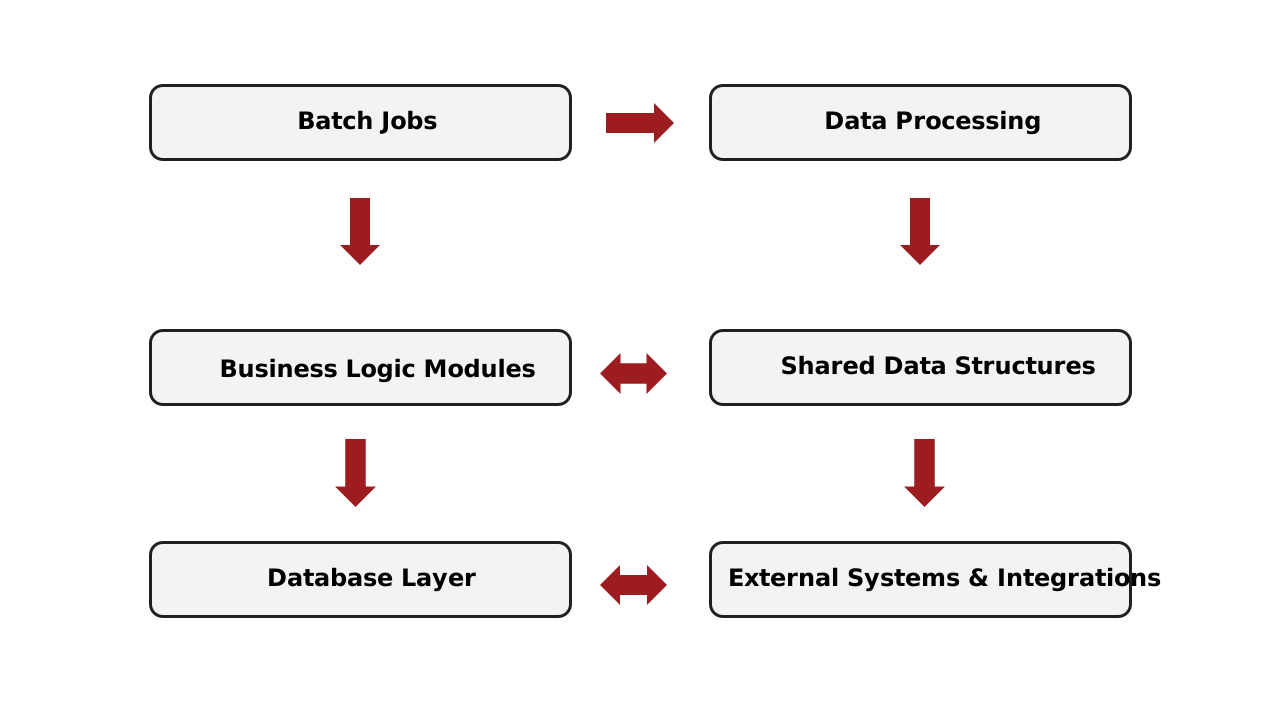
What Legacy Systems Often Look Like Internally
Over decades of development, relationships between system components become deeply interconnected.
Batch processing, data structures, application logic, and integrations with external systems form a complex network of dependencies.
Changes made in one part of the system can affect multiple other components in ways that are not immediately visible.
Why Modernization Without Discovery Is Risky
Organizations sometimes begin modernization initiatives based only on high-level understanding of their systems.
Without structured discovery, projects often encounter unexpected challenges such as:
Undocumented Dependencies
Programs and modules may depend on each other in ways that are not clearly documented.
Hidden Business Rules
Business logic may be embedded across many programs and scripts.
Complex Processing Logic
Batch processes and data flows often contain critical logic that can be missed during analysis.
Embedded Data Structures
Critical data structures may be embedded directly inside application code rather than isolated in database schemas.
Inter-Module Relationships
Programs and components often depend on each other through complex relationships that are difficult to identify without detailed analysis.
These surprises typically appear late in the project, when engineering work is already underway.
From Unknown Complexity To A Clear Blueprint
Producing a Complete Modernization Blueprint
After the AI-guided assessment is completed, the legacy application becomes a fully mapped system architecture, providing:
Complete Program Inventory
Dependency Maps
Business Rule Identification
Data Flow Analysis
Modernization Complexity Scoring
This blueprint becomes the foundation for the CORE Migration Method, ensuring that modernization proceeds with full system knowledge rather than assumptions.
Start With System Discovery
Understanding the architecture of your legacy systems is the first step toward successful modernization.