
The CORE-Directed Business Model
CLIENT ROLE
Acceptance Testing
CORE ROLE
Full Migration Discovery
APPROACH
Big Bang & Code Drops
OUTCOME
Modernized Application
We Do The Development and Functional Testing. You Do the Acceptance Testing and Implementation with our support.
CORE manages the migration process from design recovery through implementation while working closely with the client during acceptance testing and deployment.
For those clients who want to be closely involved with the migration process, understand the legacy system inside and out, but lack the team size or deep technological skill in the New Technology Stack, we offer The CORE Directed Migration Method.
With the CORE Directed Business Model, the CORE team handles the entire migration process, from design recovery, forward engineering to unit and functional testing based on test cases provided by the client. Unlike a Big Bang approach and delivering the solution at the end, the system is gradually developed and released (in Code Drops) to the client over the duration of the project allowing the client to incrementally acceptance-test the resulting solution. This ensures a smooth and efficient transition. We manage everything, with ongoing collaboration to keep you informed.
How the CORE-Directed Model Works
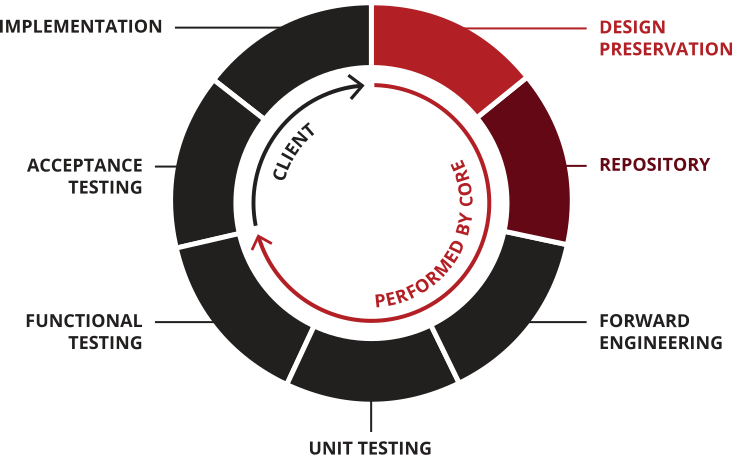
Design Preservation
CORE captures business rules and application logic during design recovery.
Repository
Migration artifacts are stored in a central repository.
Forward Engineering
CORE generates and modernizes the application using the new technology stack.
Unit Testing
CORE executes unit tests to validate the modernized components.
Acceptance Testing
The client performs acceptance testing to validate business requirements.
Implementation
The solution is deployed into production with ongoing support.
Project Delivery Approach
The CORE Directed Migration Method comprises three logical components.
The CORE team performs the procedures, operated the technology and carried out the bulk of the migration tasks for the organization’s system migration project. Once CORE ensures the source code has passed through the Forward Engineering stage, CORE executes the Unit Test plans against the newly modernized application.
The CORE team then worked with the client to build a Quality Assurance project plan which included test cases, videos of screen and batch processes, screen shots, execution times and test data. CORE uses the outputs and statistics as “anticipated results” for testing and verification of the modernized code during the Unit and Functional Test stages. To ensure 100% preservation of the functionality within the legacy application, the Functional test phase undertaken by the CORE team is rigorous and multi-faceted. Upon completion of this phase, the CORE team delivers the completed modules to the organization. The organization is then able to initiate their formal Acceptance Testing.
Related Services
Self Directed Migration Method
A collaborative approach where your team leads the migration with CORE’s guidance
Business Rules Extraction
Extract and document critical business rules during design recovery.
Legacy Application Modernization
Modernize legacy systems with new technology and improved performance.
The CORE Migration Method
Our proven methodology for successful legacy application modernization
Start Your Legacy Modernization Project
Let CORE manage the migration process while your team focuses on business priorities.